Start with the construction, not a template
“Traditional drum” is not one construction. A frame drum stretches a membrane across a shallow hoop. Other instruments use carved or built-up hollow bodies, one or two heads, lacing, pegs, wedges or adhesives. Each solution brings a different balance of weight, resonance, repair and portability.
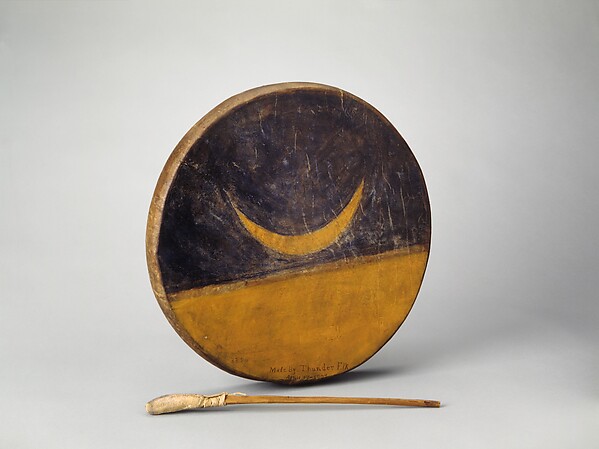
The Met’s frame drum attributed to Thunder Elk records wood, leather, sinew, metal wire and pigment. Its labelled materials support specific observation without assuming how every Sioux drum was made or used.
Bodies and membranes
A Nasca ceramic drum shows that a resonating body need not be wooden. The vessel is formed from fired clay and decorated with slip. By contrast, nineteenth-century drums catalogued from Uganda and the Democratic Republic of the Congo combine wood with animal skin.
Material names are only a first layer. Tool marks, joins, repairs and wear can reveal sequences of making and use, but those readings require conservation examination and contextual knowledge.
Sound is cultural information
Dimensions, tension and striking technique affect sound, yet the social meaning of a rhythm cannot be calculated from the instrument alone. Learning systems, ensembles, language, dance and event structure determine what listeners recognise.
Our captions therefore distinguish measurable construction from culturally held knowledge. When a source does not identify an instrument’s occasion or repertoire, we do not invent one.