An object and an event
A mask may be only one component of a larger appearance. Costume, music, choreography, speech, location and audience can carry as much meaning as the carved or assembled face. The Smithsonian’s teaching material usefully notes that “mask” can refer to the face covering together with its costume and props.
That is why this journal does not assign a universal meaning to a shape, colour or expression. A museum portrait of an object can support close looking, but it cannot reproduce the event in which that object once operated.
Different objects, different relationships to the body
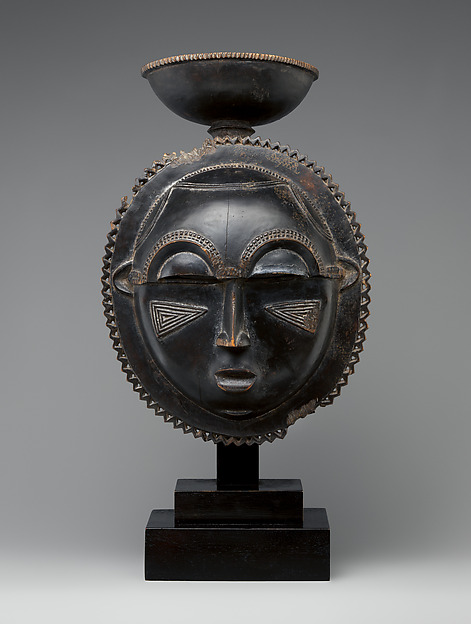
The Baule moon face mask in The Met’s collection is linked to public daytime mblo or gbagba performance. The heavy travertine face from Teotihuacan has no eye openings and was probably not worn. The Sicán gold mask belonged to mortuary regalia. Similar English labels therefore conceal fundamentally different uses.
Responsible description begins with the object record: named culture or maker, date, place, material, physical evidence and the exact level of certainty in the source.
What remains unknown
Gaps are information too. The Romkun, Breri or Igana mask in The Met is catalogued with a likely dance function, inferred from pierced eyes and attachment holes, while the wider masking tradition is described as largely undocumented. We retain that uncertainty rather than turning a possibility into fact.
When descendant-community sources or updated provenance become available, they should be read alongside—and sometimes used to correct—older museum terminology.